

Conflict is not the problem
Why nonprofit campaigns and political movements need political tension, not just talking points

Political conflict is often treated as something to be avoided.
Either neutralized in the name of consensus, or pushed to extremes in the hope of mobilizing through outrage.
Both strategies are increasingly visible, and both tend to miss the same point. Democracy, civic and activist engagement do not function despite conflict, but through it, not only by structuring electoral and ideologic choice, but by giving supporters, volunteers and activists a reason to mobilize and a clarity around why they engage.
The question is not whether disagreement should exist, but rather how it is articulated, organized, and kept within an ideological and political register.
For professional campaigners and nonprofit leaders, this is not another theoretical debate, but a practical one: it shapes how issues are chosen, lines are drawn, political choices are made legible, and supporters are moved to act.
Contemporary politics and the civic engagement sphere are often described as excessively polarized. The diagnosis is not entirely wrong, but it remains partial. Yet polarization should not be confused with political division. What characterizes the current moment is less a simple escalation of confrontation than a paradox: two opposing tendencies that ultimately converge.
On one side of the political spectrum, some actors deliberately cultivate hyperpolarization, relying on emotional escalation, moral absolutism and, at times, the designation of existential enemies as mobilization tools. And this dynamic is not limited to political parties. Advocacy organisations and NGOs increasingly find themselves drawn into the same logic.On the other side, many parties, campaigns and NGOs, eager to distance themselves from these excesses, adopt an almost symmetrical posture. They avoid divisive issues (often called wedge issues), soften their positions and censor themselves in the name of responsibility, unity or governability
Despite their differences, both approaches lead to a similar outcome. Political conflict, understood as a structured confrontation over choices and priorities, loses its substance. Either it is transformed into an existential struggle that leaves little room for disagreement, or it is neutralized in advance, leaving supporters and volunteers with few reasons to mobilize, and voters with even less clarity to choose or tired of a debate that runs hot but says nothing.
It’s not about being consensual or conflictual: the real challenge is to ensure that conflict retains a recognisably political and ideaological form.
Democracy is meant to be conflictual by design
Any attempt to address this question has to begin with a simple observation: conflict is not an accident of democratic and activist life. It is one of its constitutive elements. Democracies are not designed to eliminate disagreement, but to organize it in ways that allow collective decisions to be made and contested.
This intuition runs through the work of Hannah Arendt, particularly in The Human Condition.
Her distinction between power and violence remains instructive. Power, for Arendt, emerges from collective action among plural actors who recognize one another as participants in a shared political world. Violence appears when this shared world collapses, when disagreement can no longer be articulated through institutions or common rules.
From this perspective, an activist and political space without visible conflict is not necessarily a sign of democratic maturity. It may simply indicate that disagreement has ceased to be expressed politically.
Conflict, in democratic settings, is not a disturbance to be eliminated. It is one of the ways choices become intelligible and authority acquires legitimacy. In organizing, it is what gives people a reason to engage, not out of moral obligation or personal affinity, but because they understand where the lines are drawn.
Why politics and engagement begins with taking sides
This understanding of conflict is developed most explicitly by Jacques Rancière, notably in Disagreement.
For Rancière, politics begins with moments of “mésentente”: situations in which established arrangements are disrupted and previously marginalized voices force their way into the political conversation. Conflict is not merely the expression of competing preferences. It is a process through which political alternatives become visible and through which individuals and groups are compelled to position themselves.
A similar emphasis appears in Chantal Mouffe’s work, particularly in Agonistics and The Democratic Paradox. Democratic mobilization, she argues, depends on the existence of clear lines of division. When political actors refuse to articulate differences in the name of moderation or unity, they often weaken engagement rather than strengthening it. Choices become harder to grasp, and participation begins to feel detached from real stakes.
From this perspective, partisan divides and wedge issues are not signs of democratic failure. They are among the mechanisms through which politics becomes legible. They expose trade-offs, force prioritization and give people (voters, supporters, volunteers) a framework for positioning themselves.
On the illusion of consensus and the politics of inaudibility
Yet, much contemporary political and nonprofit communication proceeds as if this were not the case.
In an effort to appear responsible or unifying or rallying a maximum of people, many campaigns seek to neutralize conflict early on and to avoid any division or wedge issues. Wedge issues are postponed, softened or reframed as technical matters. Differences are minimized when they should instead be articulated.
When distinctions blur, people struggle to understand what separates competing projects. Politics comes to resemble a matter of tone or managerial competence rather than direction. Rather than clarifying the political landscape, this strategy tends to make it harder to read. And because nature abhors a vacuum, political and ideological division is replaced by moral polarization, emotional escalation and the designation of existential enemies, reinforced and made increasingly visible online.
Division as a mobilization strategy: Wedge issues are mobilization tools
Campaigns themselves face a similar problem. Campaigns do not only compete for support, or votes in the case of political campaigns; they rely on volunteers, activists and informal networks of supporters who give their time, energy and credibility to the cause. Without clear lines of division, it becomes harder to recruit, harder to motivate and harder to sustain engagement over time.
People rarely mobilize around vague alignments or carefully balanced positions. Engagement tends to emerge when a conflict becomes visible enough for individuals to recognize what is at stake and where they stand within it. At the same time, unresolved tensions do not disappear. When organizations and campaigns no longer provide recognizable arenas for disagreement, conflict tends to surface elsewhere, often in less structured and more volatile forms, disconnected from concrete political alternatives.
Digital platforms and the deformation of conflict
This displacement has been reinforced by the transformation of the public sphere through social media.
Shoshana Zuboff has described how the dominant business model of social media revolves around the capture of attention and the monetization of behavior (The Age of Surveillance Capitalism). In such an environment, emotional intensity becomes a central asset. Content that provokes strong reactions circulates more widely and is more likely to be amplified. But social media engagement rarely translates into real-life mobilization.
What emerges is not an excess of political conflict, but a mutated version of it: continuous, emotionally saturated, and only loosely connected to institutional outcomes.
From adversaries to enemies
These conditions are particularly advantageous for actors willing to push conflict beyond its political boundaries.
Contemporary strategies often reduce political disagreement to simplified oppositions, stabilizing emotional allegiance and casting opposing positions in moral terms.
At this point, the distinction between adversary and enemy begins to erode. Political opponents are no longer treated as legitimate competitors, but as threats whose very presence is framed as unacceptable. This logic echoes the ideas of Carl Schmitt, for whom politics was defined by the distinction between friend and enemy. While long controversial, this framework has gained renewed influence among parts of the contemporary populist sphere.
The dynamics surrounding Donald Trump’s 2024 campaign illustrate this shift with particular clarity. Electoral competition is framed as an existential struggle (rather than a contest over policy direction). Institutions are accepted only when they produce favorable outcomes. Compromise becomes suspect by definition.
Two impasses, one outcome
Faced with such developments, it is tempting to reject conflict altogether and to associate any form of polarization with democratic decline. This response is understandable, but it risks reinforcing the very dynamic it seeks to escape. On one side, hyperpolarization strips conflict of its political content by turning it into moral warfare. On the other, self-censorship and consensus-seeking drain conflict by refusing to articulate it at all. But polarization and political division are not the same thing.
In both cases, disagreement ceases to function as disagreement. It becomes either absolute or invisible.
The difficulty lies not in choosing between confrontation and moderation, but in recovering a form of conflict that remains recognizably political: structured, bounded and open to contestation.
When campaigners harness the true power of wedge issues
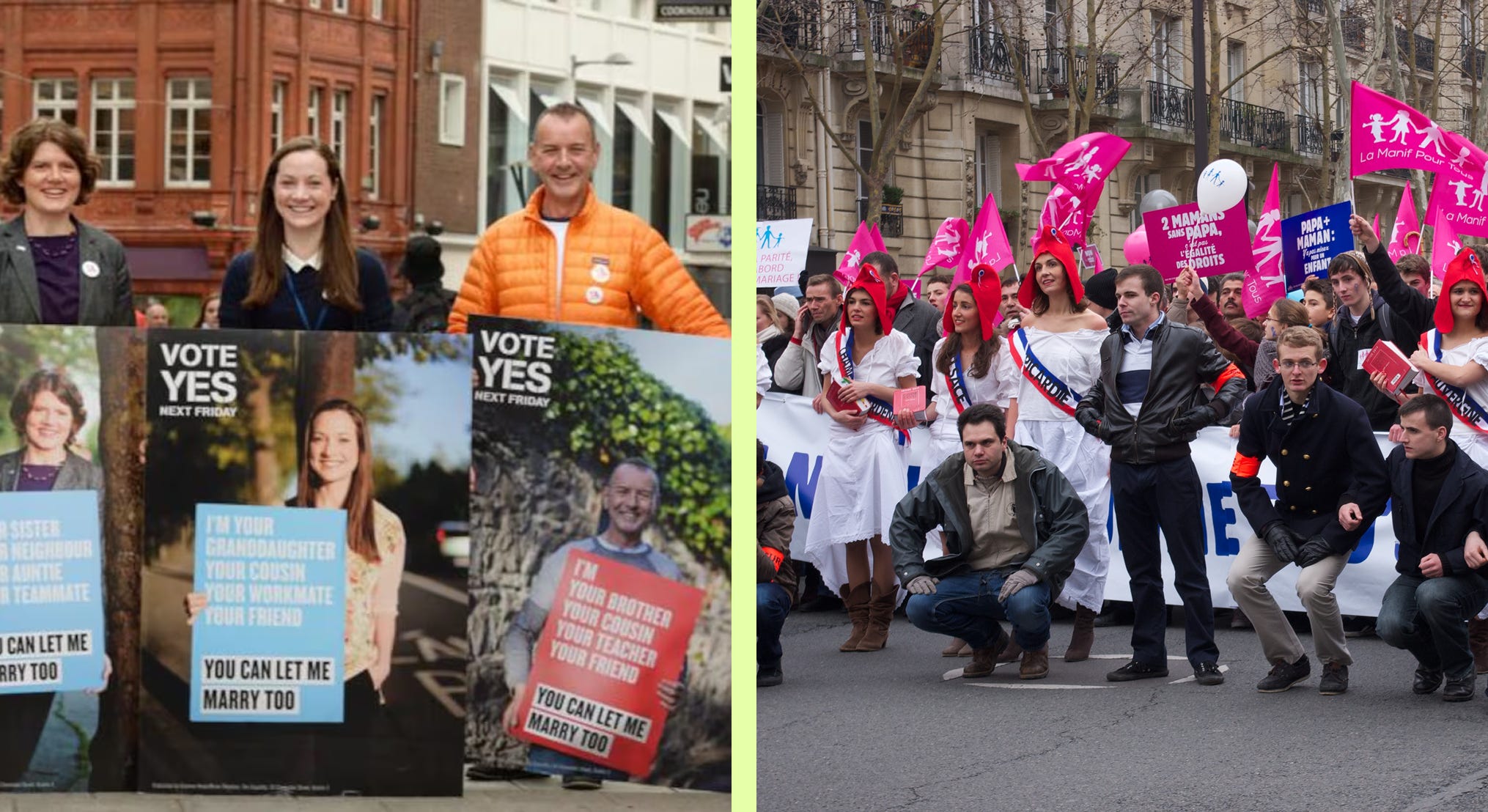
Well-documented campaigns show that successful campaigning depends less on dampening conflict than on knowing how to channel it.
The 2015 Irish referendum on same-sex marriage offers a clear example. The Yes Equality coalition embraced a wedge issue that could not be softened or diluted. The choice was explicit and unavoidable. The campaign did not attempt to eliminate the conflict; it organized it within a democratic procedure that allowed it to be resolved through a collective decision. In doing so, it transformed a divisive issue into a powerful source of mobilization, bringing volunteers, activists and supporters into a campaign that made the stakes of the vote immediately legible.
The same issue generated a strong mobilization in France with the Manif pour tous movement. While the campaign ultimately failed to block the adoption of same-sex marriage, it proved remarkably effective at mobilizing supporters, shaping politics even a decade later. Hundreds of thousands took to the streets, new activist networks were formed, and a generation of activists entered political life through the movement. Beyond the immediate legislative defeat, the cultural and political reverberations were significant. The mobilization helped consolidate a shared narrative around family, culture and national continuity, and contributed to reshaping parts of the French electorate. Many of the networks, organizations and political figures that emerged from the movement continue to structure segments of the right today, illustrating how wedge issues can produce durable forms of political identity and engagement even when they fail to deliver their immediate policy objective.
These two cases produced very different outcomes, but they reveal the same underlying dynamic. Wedge issues generate engagement because they force people to position themselves. Supporters rarely mobilize around blurred distinctions. They mobilize when a conflict becomes visible, legible and politically meaningful.
For campaigners, this distinction matters. Avoiding conflict leads to indistinction; exploiting it as pure emotional mobilization leads to escalation without exit. Between the two lies a narrower space, where disagreement clarifies choices and remains politically decidable.
Campaigns do not fail because they provoke disagreement. They fail when they treat it as a risk to manage rather than a force to mobilize. They fail when they cannot give it a form, and therefore a political exit.